As students everywhere clamber towards the end of the semester, overwhelmed with exams and projects, some will resort to self-destructive methods of meeting that task.
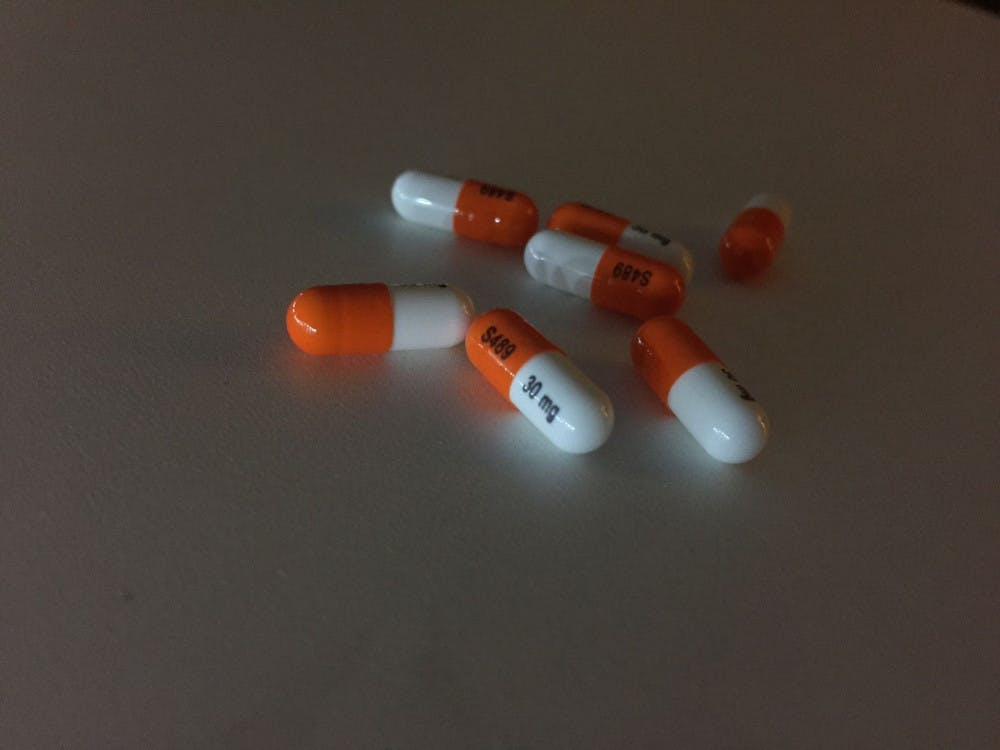
Stimulant drugs such as Adderall and Vyvanse, prescribed to patients with attention deficit hyperactivity disorder (ADHD) will find their way into the hands of students looking for a competitive advantage or a simple boost of energy.
About 31 percent of college students reported having taken prescription stimulants non-medically at some point to help them perform in school, according to a report conducted by the University of Maryland School of Public Health.
Nonmedical use includes excessive or inconsistent doses taken by patients with prescriptions, as well as illicit methods of consumption such as snorting or injecting. The study also suggests that only about 5 percent of college students actually have prescriptions for ADHD medications.
Hanna Lawhorn, 19, is a freshman sociology and international studies major and has ADHD. She has tried a host of medications and struggled with their side-effects. Still, she acknowledges a boost in performance.
“I felt more motivated to want to do all my stuff and to be prepared,” Lawhorn said about her experience with Adderall, a chemical cousin to the street drug crystal meth.
Although the similarity between prescription medications for ADHD and dangerous street drugs is common knowledge, students who are aware of the risks nonetheless opt for the aid of pharmaceuticals when the stress is too much.
Lawhorn describes the coming weeks as, “that point in the semester when there is really no off-day.”
For decades, people have turned to amphetamines in the hopes of gaining a performance-enhancing boost. During World War II, countries of both the Allied and Axis Powers gave amphetamines to soldiers and pilots to keep them awake during long missions.
After further research concluded that stimulant use carries a high risk of addiction, the U.S. Government began to regulate amphetamines under the Controlled Substance Act of 1970, and milder stimulants replaced them in most medical applications.
Diagnoses of attention disorders became more common, particularly among children, in the early 1990s. What followed was a wave of prescriptions for Ritalin: a drug first synthesized in the 1950s, which remains the most popular ADHD medication.
However, not until after the introduction of Adderall in 1996, did the rate of diagnosis begin to increase. According to the Center for Disease Control, rates of ADHD diagnosis increased by an average of three percent each year from 1997 to 2006 and approximately five percent from 2003 to 2011.
These rates continue to rise. One bloc of the working- age population that has become an enclave for stimulant abuse, however, is the world of professional gaming.
Just like athletes who take steroids to increase their physical performance, professional gamers are drawn to stimulants for the mental alertness and fast response times during play.
The phenomenon of stimulant abuse among eSports players led the Electronic Sports League to start cracking down on the problem earlier this year.
Expired weed can lead to brain damage and lung cancer. Local doctors warned others not to use drugs that are expired.