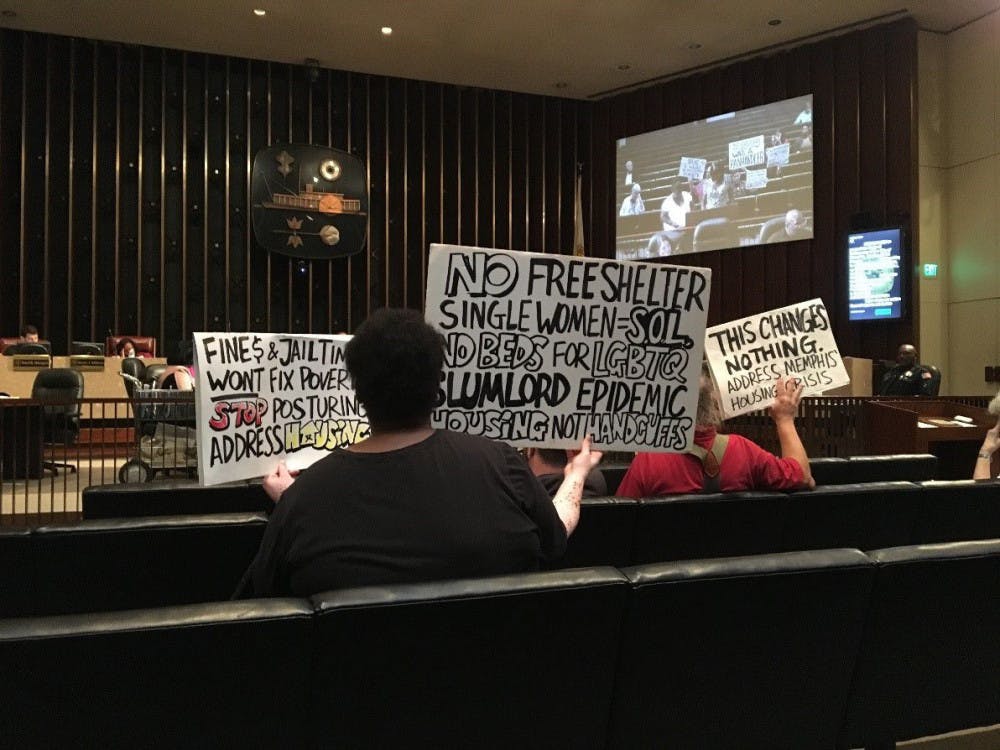
Protesters from HOPE sit silently in front of the Memphis City Council, holding signs to oppose the new panhandling ordinance. The group said the law, which restricts panhandling from 5 p.m. to 10 a.m. and holds a $50 fine, would not help the housing problems in Memphis.
Keeping a close eye on his bike, Adam sat down at the bus stop, counting the change he had gathered in his hand. Adam’s been homeless for the past 12 years and panhandles between jobs.
He said he uses the money to stay in shelters, buy food and clothes.
“It’s embarrassing and it’s the wrong thing to do, but I need the money†he said. “I try to hold a conversation with somebody, ask how their day is going, and see if they have any spare change.â€
Adam asked only to be identified by his first name for fear he might be discovered breaking the law.
In October, the Memphis City Council passed new regulations on panhandling.The law makes panhandling illegal in city limits between 5 p.m. and 10 a.m. Panhandlers cannot be within 25 feet from busy intersections and other road areas.
“The panhandling ordinance does not solve problems. It makes us comfortable in middle class.â€
-Elena Delavega
associate director of the Benjamin L. Hooks Institute for Social Change
Violators can be charged a $50 fine. Homelessness is an extreme form of exclusion and poverty said Elena Delavega, associate director of the Benjamin L. Hooks Institute for Social Change. She said the new law is only trying to hide the problem of homelessness in city.
“The panhandling ordinance does not solve problems,†Delavega said. “It makes us comfortable in middle class.â€
Delavega said that we need an increase in minimum wage, funding for shelters, rapid rehousing, and single room occupancy to help the homeless in Memphis.
“We need to implement the motto of giving housing first, then focusing on sobriety,†Delavega said. “We need to have supportive housing and help for the mentally ill.†At the city council meeting, a group of homeless advocates held up handmade signs that said “Jesus was a Panhandler†and “Housing not Handcuffs.â€
It was an effort by a group called Homeless Organizing for Power and Equality to protest the council’s move to reduce the time people are allowed to panhandle and limit where they can do it.
“They won’t be able to pay the fines so they will just end up back on the streets,†Tamara Hendrix, the organizing coordinator for HOPE, said. Toni Whitfield, president of the group, said that the ordinance does not address the real problem: the homeless crisis.
“I would like to see (the council) discussing homelessness, which is a big problem in Memphis,†Whitfield said. “They have no free housing.†Hendrix said that the shelters available now are too expensive and are often not safe.
“There’s a waitlist, and for men it’s $6,†Hendrix said. “We surveyed some folks on the street and they said they’d rather sleep on the ground than in a shelter. We need improvement and more shelters.â€
Adam said he has been in shelters, but did not have the money to stay. One of the shelters offered to homeless men is the Memphis Union Mission, a facility located on Poplar Avenue.
Steve Carpenter, the director of development at the mission, said that the facility offers much more than a place to stay for homeless men.
“We offer free lunch every day for the public, and dinner for overnight guests.†Carpenter said. “We have 120 beds, with an additional 200 temporary beds if needed. We offer hygiene kits and a clothing closet. We also teamed up with Baptist Memorial Healthcare to provide a free medical clinic every Monday.â€
Men who are employed or receiving disability checks can stay over an extended period of time at the Opportunity Center. Overnight guests who do not enter a recovery program receive four free nights a month. After that, they pay $6 a night. Guests stay for free when it is below freezing.
The mission also allows guests to stay for free if they help out with chores around the mission. All guests are not allowed to use drugs or alcohol. Even with all these available amenities, people are still begging for spare change on the side of the road.
Carpenter said that there are two main reasons for this--mental illness and isolation. “Some chronic homeless people deal with mental illness while some just do not like the group context,†Carpenter said. “A few winters ago, we had some really harsh weather. We were open and the city set up temporary warming centers and offered transportation, but people still froze to death that winter because they just would not come.â€
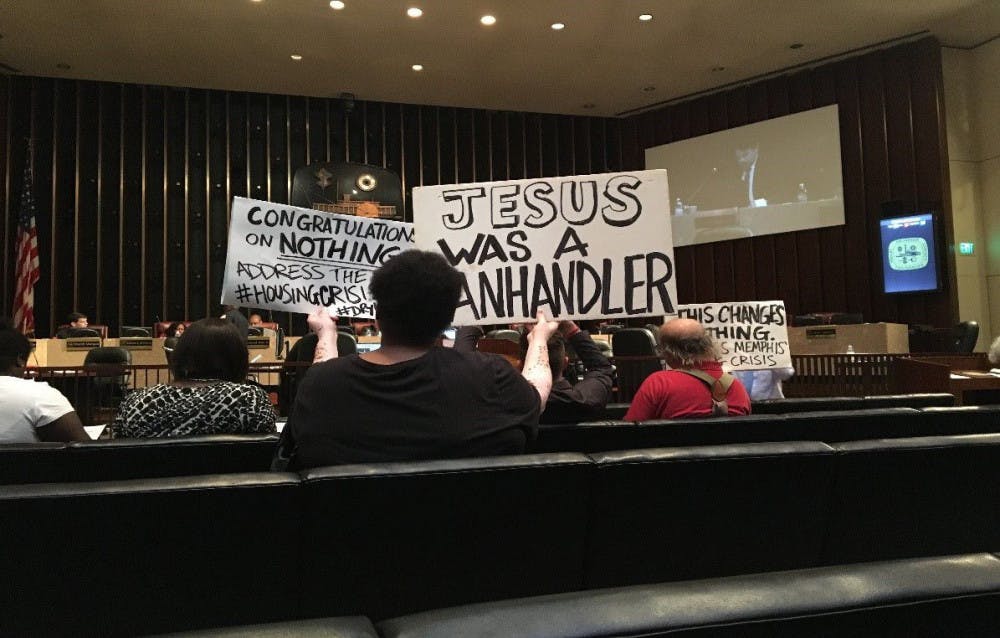
Memphians protests the new ordinance on panhandling. The city council passed an ordinance to prevent homeless people from panhandling during certain times of the day.
Â
Â
Another aspect of the mission that may turn people away is the structured schedule, Carpenter said.
“We have mandatory chapel services and set times to wake up and go to bed,†Carpenter said. “We also require the men who stay the night to take a shower. Some don’t like the idea of having to do something organized.â€