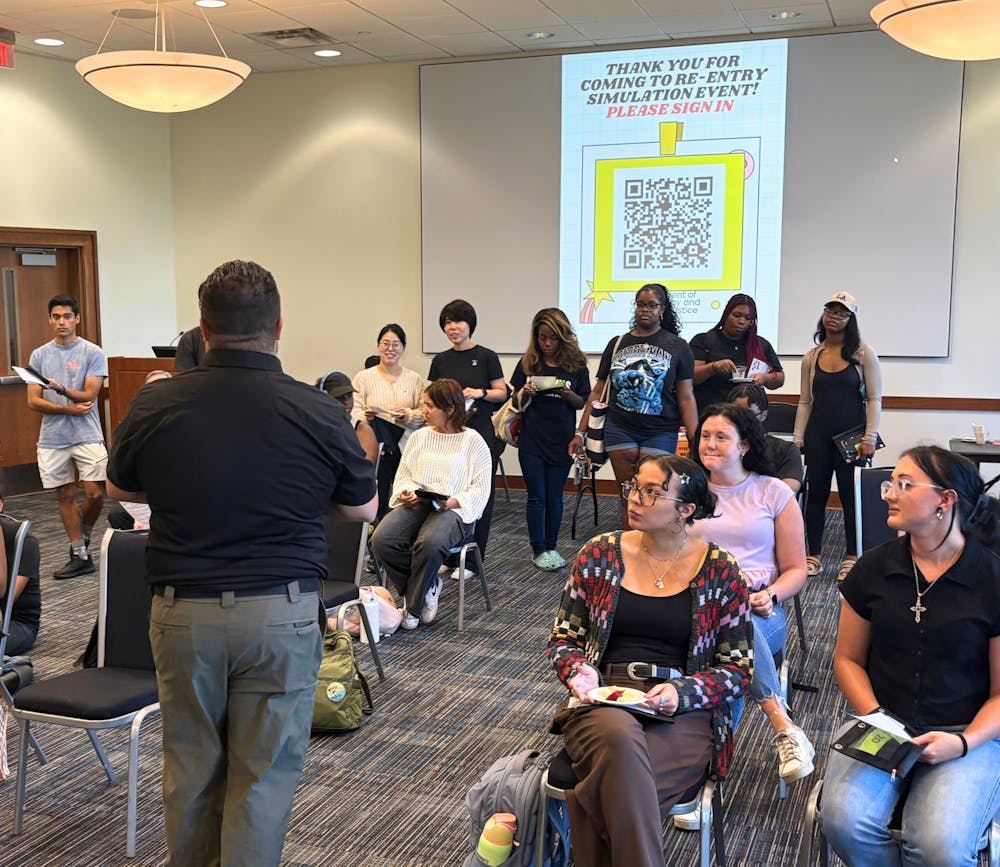
The University of Memphis Department of Criminology and Criminal Justice teamed up with the Federal Bureau of Prisons, Shelby County Office of Reentry, and other organizations, to create and host a “reentry simulation,” for their students Tuesday afternoon.
The unique simulation offered a direct insight into the challenges, lives, and daily struggles of formerly incarcerated individuals, placing students directly in their shoes.
The event took place in the UC Bluff Room and was filled with students. As students arrived, they were given different packets, which inside gave them their role for the simulation. After opening their packets and establishing their roles, students then had to go to various labeled tables found within the room to take care of different situations that someone coming out of prison would have to deal with.
Whether that be getting an ID, applying for a job, visiting probation officer, or even trying to sell things to the pawn shop or donating plasma for the chance to get money within the simulation, every step of the process was covered.
Patrick Backus, reentry affairs coordinator for the Federal Bureau of Prisons, facilitated the event. He said the goal was to help students better understand the stressors that justice-involved individuals face.
“We are bringing individuals in that are going through the criminal justice program and putting them through the life of an individual that’s been incarcerated and reentering society and just giving them the hiccups and some of the stress that goes with that,” Backus said.
Backus added that the exercise highlights the unequal experiences of people returning from prison.
“It gives them a better understanding, and we’re trying to design the empathy part of life that when entering the criminal justice world, not every criminal is going to get the same shake as the individual next to them,” Backus said. “Individuals that face justice involvement might have burdens that prevent them from staying out of prisons, or frustrations of coming into a world after being incarcerated for five, ten, or fifteen years."
This was Backus’s third time leading the simulation, though his first with students. He has previously hosted it for court officials, justice system members, and judges and says it often makes a positive impact.
“There’s federal guidelines that they must sentence individuals with, and they can go heavier, or they can go lighter on them,” Backus said.” What it did was help instill the empathy portion of thinking, that if I put a person on supervised release for ten years, that’s ten years of them having to do exactly what they just did in the simulation. A lot of them have reduced their supervisor release limitations.”
Students who took part said how eye-opening the experience was for them.
“You don’t understand something until you experience it yourself, and this is just a simulation — this isn’t even the real world of what they have to go through,” said Moses Davis, a junior at the University of Memphis. "Just feeling the stress here, I couldn’t imagine having to actually go through this.”
The Department of Criminology and Criminal Justice will hold its next event, an information fair for undergraduates interested in the master’s program, on Oct. 7 from 11 a.m. to noon in the UC Memphis Room.
Sam Trigg can be contacted at sctrigg@memphis.edu.