
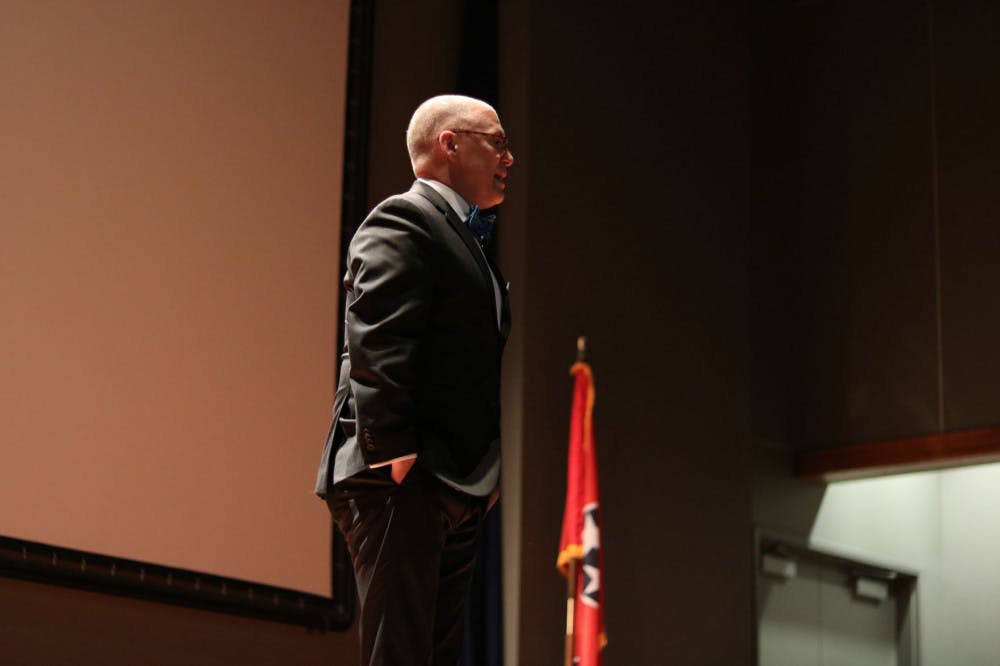
Jim Obergefell, LGBTQ+ activist and main plaintiff in the 2015 Obergefell v. Hodges United States Supreme Court case that legalized same-sex marriage, spoke at the University of Memphis on Wednesday night.
Obergefell spoke about his experiences with his late husband John and his activism for marriage equality for about an hour in the University Center Theatre during the event hosted by Stonewall Tigers.
Obergefell began by emphasizing how challenging it was to officially come out as a gay man, internally struggling with it until after he graduated from college. He said it took one of his friends asking him if he was gay or straight before he had the courage to come out.
“For those of you who have been through that process, in that moment, you understand the weight that has been been lifted from your shoulders, that feeling of relief,” Obergefell said.
Obergefell explained the harsh discrimination in the “gay-unfriendly” city of Cincinnati, Ohio, when he and his eventual husband John were living there.
“Cincinnati police would arrest single men sitting in a car at a public park,” Obergefell said. “Dentists refused to serve gay men. There was a lot of discrimination happening in the city.”
By 2011, Obergefell and John had been together for eighteen years when John began showing signs of a medical issue.
“When he walked, it sounded like one foot was slapping the ground harder than the other,” Obergefell said. “The slapping sound didn’t go away, so I finally convinced him to go to the doctor.”
After several visits to the doctor, John was diagnosed with ALS (amyotrophic lateral sclerosis), a disease that slowly deteriorates the body due to a loss of connection between the brain and the muscles.
John eventually lost the ability to walk. Instead of bringing John to a facility, Obergefell brought hospice care to their home. Obergefell said this and several previous Supreme Court case decisions pushed him to marry John.
Obergefell and several other plaintiffs worked together to federally legalize same-sex marriage through the Supreme Court. On June 26, 2015, the Supreme Court ruled in favor of Obergefell and required all 50 states to issue marriage licenses to same-sex couples.
Obergefell said many people reached out to him about their experiences and felt inspired by his actions following the case.
“I’ve had countless people stop me, hug me, show me photos, show me loved ones, show me their photos of ones they’ve lost,” Obergefell said.
Andrew Phifer, vice president of Stonewall Tigers, said the organization wanted to bring a key figure in the LGBTQ+ community to come speak.
“It was incredibly humbling having him here, and it was incredibly emotional,” Phifer said. “It makes me want to go out and do a lot more than what we are doing now, and actually go out there and be the proper activists that we should be. He was excited to be there and talk to college students because he just wants to share his story.”
Phifer said he was pleased with the crowd and saw the event as a success.
“I want to say it was a total hit, in my opinion,” Phifer said.
Jim Obergefell talks about his relationship with his late husband John and the lead-up to and the aftermath of the Supreme Court decision. Obergefell said this time of year is usually hard for him, as it is only a few days after the 5-year anniversary of his husband's death.
Jim Obergefell gives his autograph to an attendee. Obergefell stressed voting is important, as the current Supreme Court members may have a different decision on LGBTQ+ issues than the Supreme Court members in the Obergefell v. Hodges case.
Stonewall Tigers President Cody Averett introduces Jim Obergefell to attendees in the UC theatre. Stonewall Tigers organized the week's events, including Obergefell's speech, for the annual LGBTQ+ week at the University of Memphis.


