
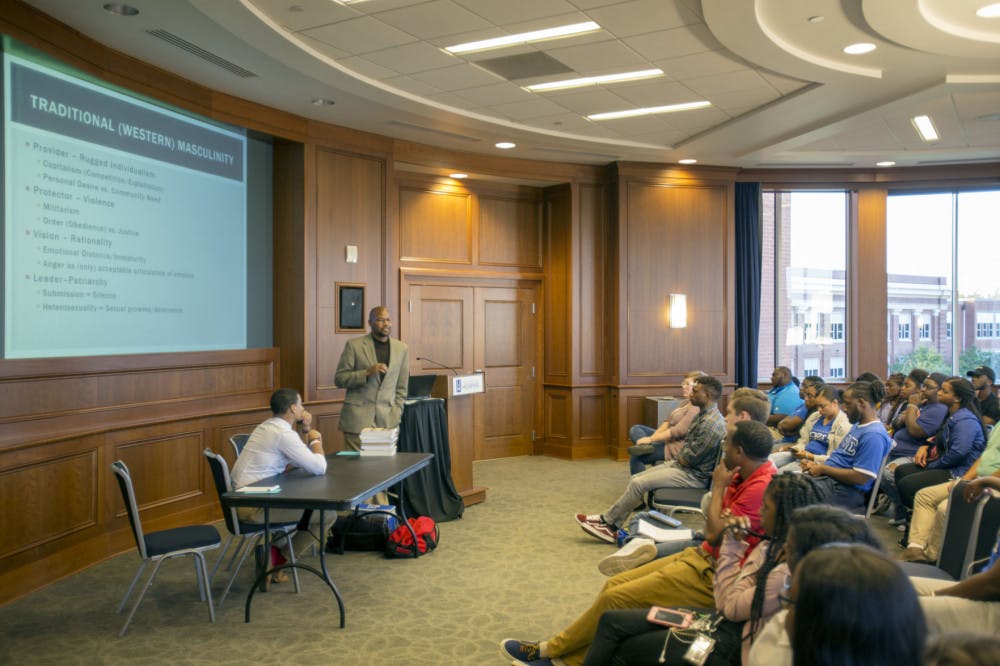
Hegemonic masculinity is defined as the practice of men’s justification of their dominance over women and other men not seen as masculine within a society. These representations support stereotypical, heterosexual and masculine values in the cultural structure.
In western cultures, masculinity is often conceptualized as being strong, not showing emotions, protecting what is one’s own and being the breadwinner.
“If what it means to be masculine is to be a breadwinner, what does that mean if the woman is the primary breadwinner, or your other partner is the primary breadwinner?” Corey Reed, who has a doctorate in philosophy and works in the philosophy department at the University of Memphis, said.
Toxic masculinity, a subset of hegemonic masculinity, can be categorized by the implementation of rigid gender roles and includes the need to aggressively compete and dominate others. It also includes the support of homophobic and misogynistic views of people inside a society.
“Toxic masculinity is not just an exclusive male issue,” Reed said. “It is an issue for us as an entire society for us to be challenging some of the ways in which we are rearing our young men, rearing our young women and how they are identifying with themselves.”
Reed said people should feel the need to free themselves from aspects of masculinity that could be seen as toxic or damaging to those around them.
Rape culture is another part of hegemonic masculinity, which includes things like “locker room talk.” Rape culture presents rape as an unavoidable or even common activity in a society. Instead of it being seen as a criminal act, rape culture is one in which the offenders are seldom incarcerated and the victims are blamed. It is commonly found in many institutions that are predominately male-dominated, such as universities, prisons and within the military and sports.
Terrence Tucker, an English professor at the U of M, said people use language such as “boys will be boys” to hide or justify actions.
Tucker said Dan Turner, the father of Brock Turner, an athlete in California who sexually assaulted an unconscious woman, exhibited this when he defended the actions of his son by saying, “These verdicts have broken and shattered him and our family in so many ways. His life will never be the one that he dreamed about and worked so hard to achieve. That is a steep price to pay for 20 minutes of action, out of his 20-plus years of life.”
In this situation, toxic masculinity not only came from Brock Turner, but Tucker said one can see how it was learned behavior from his father. Tucker said Dan Turner seemed bewildered at the verdict, but what Brock Turner did constituted rape. Brock Turner was sentenced to six months but ended up serving just three months when he faced a possible sentence of 14 years.
“Black men, historically, have been excluded from these concepts of masculinity because of slavery and because of segregation,” Tucker said. “Black men have traditionally been excluded from that with sometimes very damaging and dangerous results.”
Henry Cash, III, a student at the U of M who works with the Office of Multicultural Affairs, said how society views concepts of masculinity and race needs to be examined.
“I think this conversation about how we socialize people, in general, is important in understanding where we get traditions from and how (they) also help people understand who came up with these social constructs, why they came up with them, and are they healthy or are they unhealthy,” Cash said. “Let’s stop them and replace them with some healthy ways to become better human beings.”
Terrence Tucker and Corey Reed lead a discussion on toxic masculinity in society. This event was sponsored by Safety Net, a student-led, on-campus support group for survivors of sexual assault and allies.


