
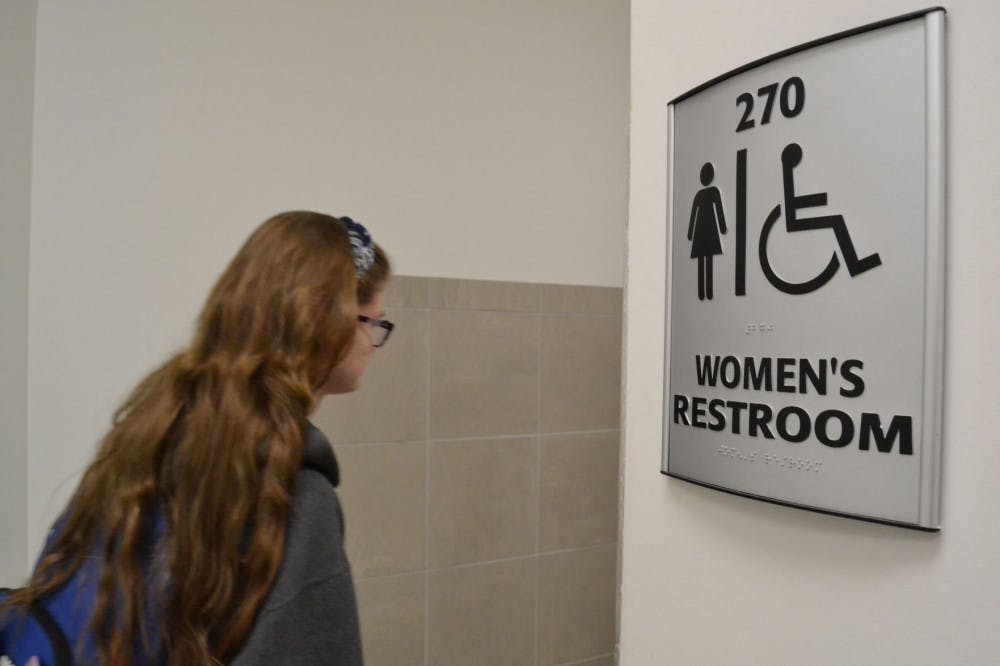
A student goes into the women's restroom on the second floor of the University Center.
Many women’s restrooms across the University of Memphis’ campus lack disposal units for feminine sanitary products inside the restroom stalls.
Disposal units for feminine products provide safe and discreet disposal of tampons and sanitary napkins. Without them, female students must carry soiled products through a public restroom to the trash can or flush them down the toilet. Feminine products are nondegradable and can clog a toilet.
Ron Brooks, assistant vice president of the physical plant, said his department would look into adding more receptacles. He said some receptacles have been moved and could not be found, and receptacles for feminine napkins eliminate plumbing problems.
“In our quick canvas of buildings today, 21 of the nearly 90 buildings on the main campus did not have feminine napkin receptacles,†Brooks said. “Where they are missing, physical plant will replace or add them … as soon as possible.â€
Julian Boyland, manager of facility operations and maintenance for the physical plant department, said many campus buildings are old, and feminine product receptacles were not implemented at the time they were built.
Academic buildings such as Mitchell Hall, Clement Hall and Patterson Hall have no sanitary product receptacles inside the women’s restrooms, and the Tiger Den dining hall restrooms do not either.
Receptacles are built into restroom stall walls in several newer buildings, including the University Center, McWherter Library and Wilder Tower. The U of M Bookstore provides small individual trash cans inside each stall.
The United States Occupational Health and Safety Administration does not require disposal units for feminine products in individual restroom stalls, but it does require any disposal of waste from restrooms not to cause unsanitary conditions, according to its regulations.    Â
Local establishments with a health permit from the Shelby County Health Department, such as restaurants and kindergarten through 12th grade schools, must have one feminine receptacle per stall with a lid, Kacey Alexander, a health department representative, said. She also said the health department does not issue permits to colleges.
“I think the lack of receptacles is a problem on campus,†Ally Goins, 21, creative mass media major, said. “That’s horribly embarrassing and inconsiderate for women not to have that access.â€
Goins said although there are places on campus to get free condoms, such as the Student Health Center, free sanitary products are not provided in the women’s restrooms.
A health center representative said the center does not provide tampons or pads to female students.
“The free condoms program we have at the health center is actually provided by Planned Parenthood,†Linh Luu, health educator at the center, said.
Women’s restrooms on campus also do not include dispensers from which female students would be able to quickly purchase sanitary products.
“I think it would be a good idea to have pad dispensers and tampon dispensers,†said Carla Robinson, a 23-year-old earth science major.Â
Robinson said she also thinks sanitary wipes and air freshener are needed in the restrooms.
“It would be good if we had sanitary things, such as wipes or spray, to wipe things down,†Robinson said. “It would be good if we had hygienic things altogether.â€


