
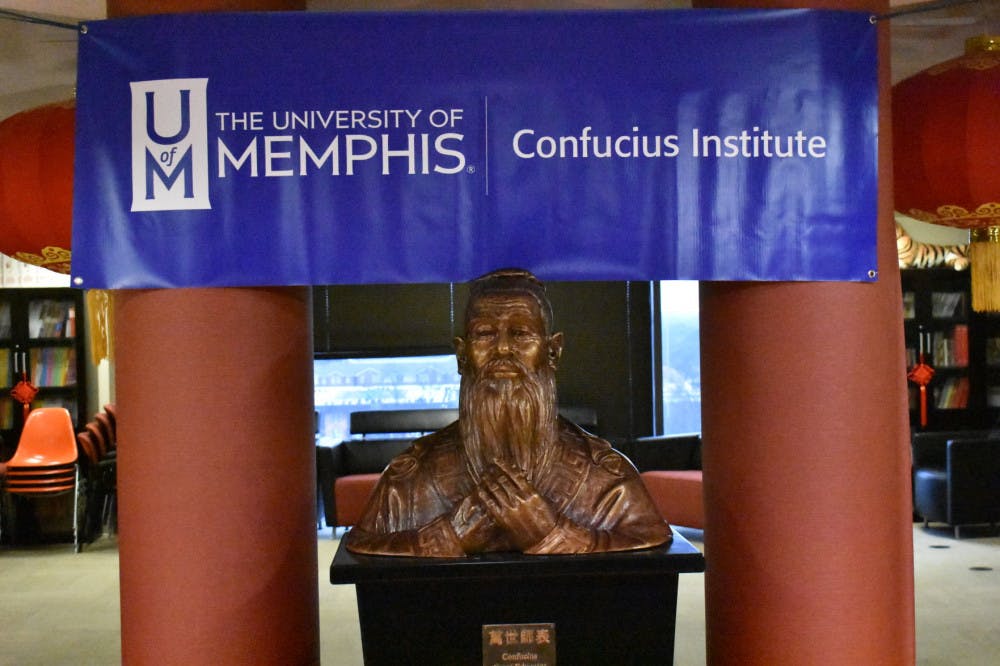
Confucius Institutes around the country were brought into question when Sen. Marco Rubio (R-Florida) wrote letters on Feb. 5. to five Florida colleges urging them to cut ties with these organizations found on their campuses.
Confucius Institutes are non-profit organizations headquartered in Beijing that focus on educating schools and communities about Chinese language and culture, encouraging multiculturalism and promoting positive relations with China. The University of Memphis houses its own Confucius Institute on Wilder Tower’s 11th floor, adding to more than 100 institutions located on campuses across the United States and more than 500 worldwide.
Rubio wrote that Confucius Institutes are run by the Chinese government with the mission of spreading communist Chinese propaganda submersed in their teachings.
In his letters, Rubio conveyed a strong distrust for the institutions, addressing them as “China’s aggressive campaign to ‘infiltrate’ American classrooms, stifle free inquiry and subvert free expression both at home and abroad.”
In response to Rubio’s statements, FBI Director Christopher Wray also said that the bureau shares “concerns about the Confucius Institutes.”
This is not the first time Confucius Institutes have been surrounded with controversy. Concerns arose when the University of Chicago and Pennsylvania State University both cut ties with their Confucius Institutes in the same week in 2014. More recently, Politico described the Confucius Institutes motivations as “a little less wholesome and edifying than they sound” on Jan. 16, joining many other media outlets that continue to express the same level of distrust for the Chinese organizations.
In light of the controversy, U of M geology professor and Confucius Institute of Memphis (CIUM) Director Hsiang-te Kung said he is not a communist and described the CIUM as “very clearly defined, non-political, non-religious, non-profit.” Having started the CIUM himself through a written proposal to the U of M, Kung said he does not report to the Chinese government, and the organization has “nothing to hide.”
“We are very transparent,” Kung said. “We are very open. We are very sincere, and we simply want to do a good job not just for the Chinese but also for Americans who are interested in China and want to know more about China.”
CIUM was founded in Aug. 3, 2007, by Kung, who said he is a 75th generation Confucius descendant. Being the first of its kind in Tennessee and the Mid-South at the time, CIUM has since operated by spreading Chinese culture and language through multicultural events and helping the community in matters dealing with Chinese language and translation.
Kung said the purpose of the CIUM is not only to educate U.S. citizens on Chinese culture but also to have the Chinese learn more about U.S. culture, a process he referred to as “two-way learning.” He said the institution has never been used for Chinese government promotion or propaganda.
Kung said the CIUM has aided the U of M for years by helping to acquire donations, books and funding. He said the CIUM’s contributions to the university and his 37 years as a U of M professor have built a solid reputation for him and the organization. Kung said he welcomes anyone to examine the CIUM and its staff because he is confident in the organization’s mission.
“I don’t think we should be threatened by anyone because we are working from our heart,” Kung said. “Like Confucius said, ‘Start with your own heart, be honest and then people will understand and appreciate what you are doing.”
Thomas Nenon, dean of College of Arts and Sciences, said he oversees the activities of CIUM and is confident in the institution’s leadership and purpose.
“The things that people are concerned about in other places are not things to be concerned about here at our Confucius Institute,” Nenon said. “I have not seen anything that they do that is not directly related to culture and language, and I haven’t seen any attempts to influence the political opinions of any student groups or the curriculum.”
The CIUM spearheads the Asian studies and international trade degree program on campus. It also plays a role in recruiting students for the program and establishing academic opportunities for them such as exchange programs. However, Nenon explained the organization does not control any of its courses, decide any curriculum or hire any faculty, all of these duties are carried out by the regular U of M departments.
Catherine Phipps, U of M director of international studies, called Rubio’s stance “unfortunate” and said it misrepresents the purpose of international studies. She said she does not think the U of M should be worried about its Confucius Institute.
“There’s an important component that the Chinese government is involved, but I don’t think they’re doing anything nefarious, and I don’t think our students need to be concerned about being poorly influenced by them,” Phipps said. “I’m more concerned that Rubio is trying to send a message that I think harms our relationship with China.”
Florida Senator Marco Rubio recently accused Confucius Institutes of being "Chinese government-run" tools "to expand the political influence of the PRC (People's Republic of China)." The U of M has its own Confucius Institute located on Wilder Tower's 11th floor.


