

When Miea Williams finally had her revelation, it was almost too late. A trip to the emergency room on a Sunday night in 2005 not only saved her life, but served as the wake-up call she needed to take back control of it.Â
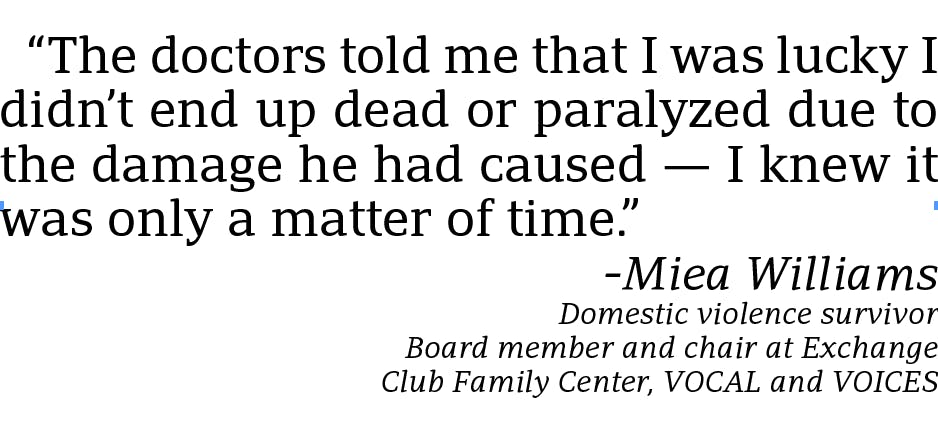
“The doctors told me that I was lucky I didn’t end up dead or paralyzed due to the damage he had caused — I knew it was only a matter of time,†Williams said. “I realized that I could not continue to allow my children to live in that type of environment. I could not allow them to grow up thinking abuse was okay — either as a perpetrator or a victim.â€
Coming out against her husband was difficult for Williams. She kept everything a secret to protect him and his reputation. He was a well-respected ordained minister who became afflicted by addiction issues. Even through all of his abuse and mounting problems, Williams continued to stand by and love her husband. Williams said her own insecurities and ignorance led her astray.
“Even as I was hurting and ashamed, I did not want people to look at him differently or to see him in a negative light,†Williams said. “It was all about perception, my own personal perception of what I thought a marriage and a wife should be.â€
Williams is nowhere near the only domestic abuse victim who calls Memphis home.
According to data collected by former University of Memphis criminology professor Richard Janikowski and the Memphis Police Department, there were 16,820 total domestic violence cases reported in Memphis in 2016. Of those cases, 9,054 involved intimate partners. African-American women make up 68.3 percent of the women who report these intimate partner incidents.
The issue is worse considering those aforementioned numbers only reflect the incidents that are reported. Award-winning women’s advocate and Memphis Area Women’s Council executive director Deborah Clubb said the majority of domestic violence incidents go unreported.
“Remember that if women have any other way to deal with this other than calling the police, we will,†Clubb said. “If we have any supportive family, friends and financial resources, we will deal with this without police as long as possible.â€
Clubb said one in four episodes of physical domestic partner violence are reported to law-enforcement. Even more traumatizing for victims are the thousands of episodes involving verbal and emotional abuse, which are not punishable by law.Â
Besides advocacy and training, the Woman’s Council is also involved with policy change, community outreach and education. They refer victims to valid agencies and work with them to become advocates who promote awareness for employers or students.
One victim-turned-advocate is Williams, who joined with Survivors of Abuse Reuniting (SOAR) when she walked away from abuse 12 years ago.
“I go out to community events to educate and raise awareness about domestic violence,†Williams said. “When I attend rallies or events, I always walk away encouraged by the strength of the survivor to take the initiative to walk away, no matter how difficult it may seem.â€
Williams didn’t stop with rallies and events. She went back to school to get her master’s degree in counseling, and then volunteered her counseling services to the community. Through her hard work, Williams earned board and chair positions at Exchange Club Family Center, VOCAL and VOICES.Â
“There are people, organizations and agencies that are designed to help victims overcome their situations,†Williams said. “This is why it is so important to educate and raise awareness of domestic violence so that victims will know that they have a way out, they have somewhere to turn and that they have a listening ear when they decide to get the help that they need. There is still hope.â€
A few places nearby with available counselors are the Exchange Club Family Center, the Shelby County Crimes Victim Center and Wilder Tower on campus. The counseling offices at Wilder Tower are located in room 214, and accept appointments online (www.memphis.edu/counseling) as well as walk-ins between 10 a.m. and 3 p.m. Monday through Friday. There is a complete list of domestic violence resources in the Memphis area at www.memphissaysnomore.com, and 1 (800) 799-7233(SAFE) is the National Domestic Violence Hotline.Â
“Break the silence to stop the violence,†Clubb said. “Being battered or beaten or abused is not your fault — it is wrong. The person doing the beating or abusing or controlling or terrorizing is the one who is wrong and should be stopped.â€


