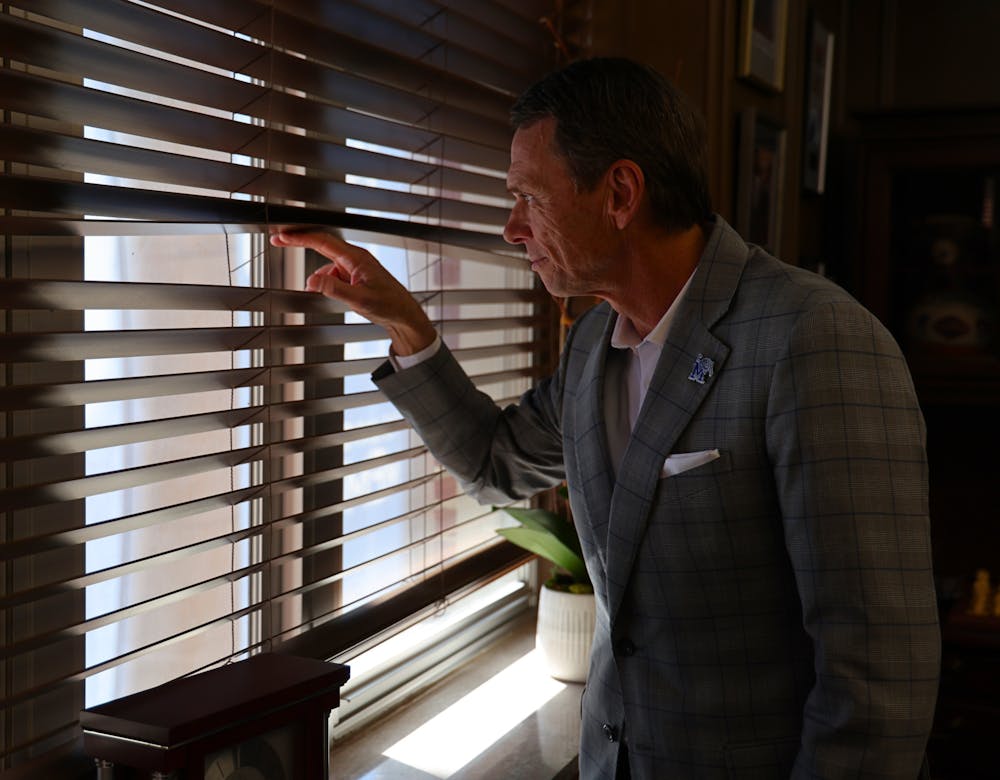
After three years in office, University of Memphis President Bill Hardgrave has faced a decade’s worth of major issues in just the past three months.
The university’s $250 million bid to join the Big 12 Conference was rejected for seemingly no reason given to the public. New state laws forced the university to shut down the Office of Multicultural Affairs and the potential deployment of federal agents on campus with the arrival of the Memphis Safe Task Force has sparked fear among many students.
With circumstances like this, it’s no wonder that there is a cloud of uncertainty among the university community. To clear the air, The Daily Helmsman sat down with Hardgrave to address the current climate in a one-on-one interview.
This interview has been lightly edited and shortened for clarity.
Daily Helmsman: You were sworn in April 2022. How has your tenure been so far?
Hardgrave: It’s gone by very, very quickly. My wife and I love it here. We love the city and we’ve enjoyed every moment of it and I can’t believe it's been over three years already. We’ve enjoyed the city. We’ve enjoyed the restaurants and all the things that come with being in Memphis.
DH: There has been a major push for the University of Memphis to join the Big 12 Conference, but despite our best efforts, we were declined again in July. Was there a particular reason for that decision, and will we keep pushing to join?
Hardgrave: I’ve had very positive conversations with the members of the Big 12, but it comes down to a lot of small things happening at once. College athletics is very different than it was five years ago and right now, it’s going through a transformation unlike anything I’ve seen in 30 years of working in higher education.
That transformation creates a lot of uncertainty and uncertainty also creates hesitation. I don’t think there are really any particulars behind why we were denied other than it being a matter of timing. It’s a matter of fit, it’s a matter of where higher education is going and again, there will be more conference alignments. We need to make sure that we stay competitive, be the best athletics program we can. When that realignment comes and there needs to be some shuffling, we are going to be at the head of the line.
DH: The Liberty Bowl’s acquisition and renovation has been a major highlight of your tenure so far. Some say the university is becoming a sports-first institution at the cost of academics. Do you agree with that sentiment?
Hardgrave: It’s a lot more complicated than that. We have great athletic programs here, but the athletic and academic sides are complementary to each other. Our vision has always been to be a nationally recognized public research university.
But how do you get nationally recognized? One way to do it, and often the quickest and most far reaching is through athletic programs. A few weeks ago, we played Arkansas and we were on ABC, coast to coast. People watched our game. People were introduced to the University of Memphis who may have never seen us before. Those games become a window for us to invite people here.
As an R1 institution, our academic reputation is growing, partly because of athletics. To maintain that status, we need to attract out-of-state students, and sports serve as great advertising. Our football and basketball teams are both top-25 programs, and there are only seven schools in the nation that have both programs in the top 25.
DH: There’s a lot of political focus on Memphis, both nationally and locally. The closure of the Office of Multicultural Affairs drew particular attention. Do you worry that continued political scrutiny could harm the university?
Hardgrave: When that (political focus) happens, you have to hold onto your North Star. In the midst of a storm, you got to hold onto that one thing that keeps you centered, and for us, that’s our commitment to a successful outcome for every student.
We have to stay committed to a successful outcome for every student and we have to stay laser focused on that. It’ll come and go and things will change. Many universities start to struggle when they try to chase the flavor of the day politically. We have to choose what is best for our students.
I talk to our faculty and student leadership and if we can stay focused on that (success), all the rest of the stuff going around, it’s just noise.
DH: The Memphis Safe Task Force has been a hot topic. Some are concerned about the National Guard or federal agents being deployed on campus. Have you been in communication with local or state officials about this?
Hardgrave: Let me start answering that question by saying our campus is incredibly safe. When I came back in 2022, both the city and the campus were experiencing some pretty drastic increases in crime. I went to the governor and asked for them to help make this campus safe again. To their credit, the governor gave us grants. $5.4 million that year, $5.4 million the next year, $3 million in a special session. And as a result, our crime is down 60% after two years
We have drone officers, canine officers, we have a crime information center where there’s 1,300 cameras tied in together. I mean, we have a really safe campus. When the announcement about sending additional law enforcement, I talked to the mayor. I talked to the governor. I talked to our federal delegation.
I don’t anticipate any additional law enforcement being here on our campus because it's needed elsewhere.
DH: Across the United States, several college professors and employees have been fired for their own personal comments and opinions in the current political environment. Historically speaking, the University has ranked very low on several independent studies about freedom of speech on campus. Has the UoM Administration needed to have a conversation regarding freedom of speech amongst employees?
Hardgrave: It’s always an ongoing discussion. Freedom of Speech is a right of everyone. It’s a cornerstone of America. Unfortunately, over the past several years, what defines freedom of speech has gotten really cloudy. I think part of it is somehow we’ve lost the ability to have dialogue with those we disagree with and from there, it turns into something that is mean and nasty. When things get that nasty, you get asked where the line is.
We have to return to the point where we can actually have civil discourse where we can have a conversation, disagree, and not have this whole “I’m gonna shut you down because I disagree with you.”
I think that’s where we struggle in higher education is maintaining that level of freedom of speech in today’s context. We want people to have conversation. We want people to disagree, but to disagree civilly. And if we can do that, freedom of speech doesn’t become an issue.
DH: Are there any areas of the university you feel need more attention?
Hardgrave: I’m going to return to what I said earlier. We need something to focus on. We need a focus on a successful outcome for every student. We have to make sure that we have the right programs, the right facilities, and we have to make sure we have the right support.
From the perspective of the facilities, we build a couple of things, but I think the days of building tons of new stuff here are over. It’s about maintaining what we already have. We have a problem called deferred maintenance which is built up over time. It’s a big problem and we have buildings that need some serious work, so we are working to address that.
DH: Calling back to restaurants earlier, do you have a favorite place to go in the city?
Hardgrave: If you are going to make me pick just one, it’s going to be the Tiger’s Den. I’ve got to promote it, it's my job. I enjoy the variety and seeing all the students and staff there.
Outside of the campus, there’s a lot of restaurants that my wife and I love to visit. It really shocked us when we came to Memphis because we didn’t know there were so many good restaurants in this city. It’s really hard to say our favorites because if someone asks me, I have to respond with, “What kind of food are you talking about?” We have our favorite seafood, favorite Italian, and so forth.
Jamie Markham can be contacted at jmrkham1@memphis.edu.