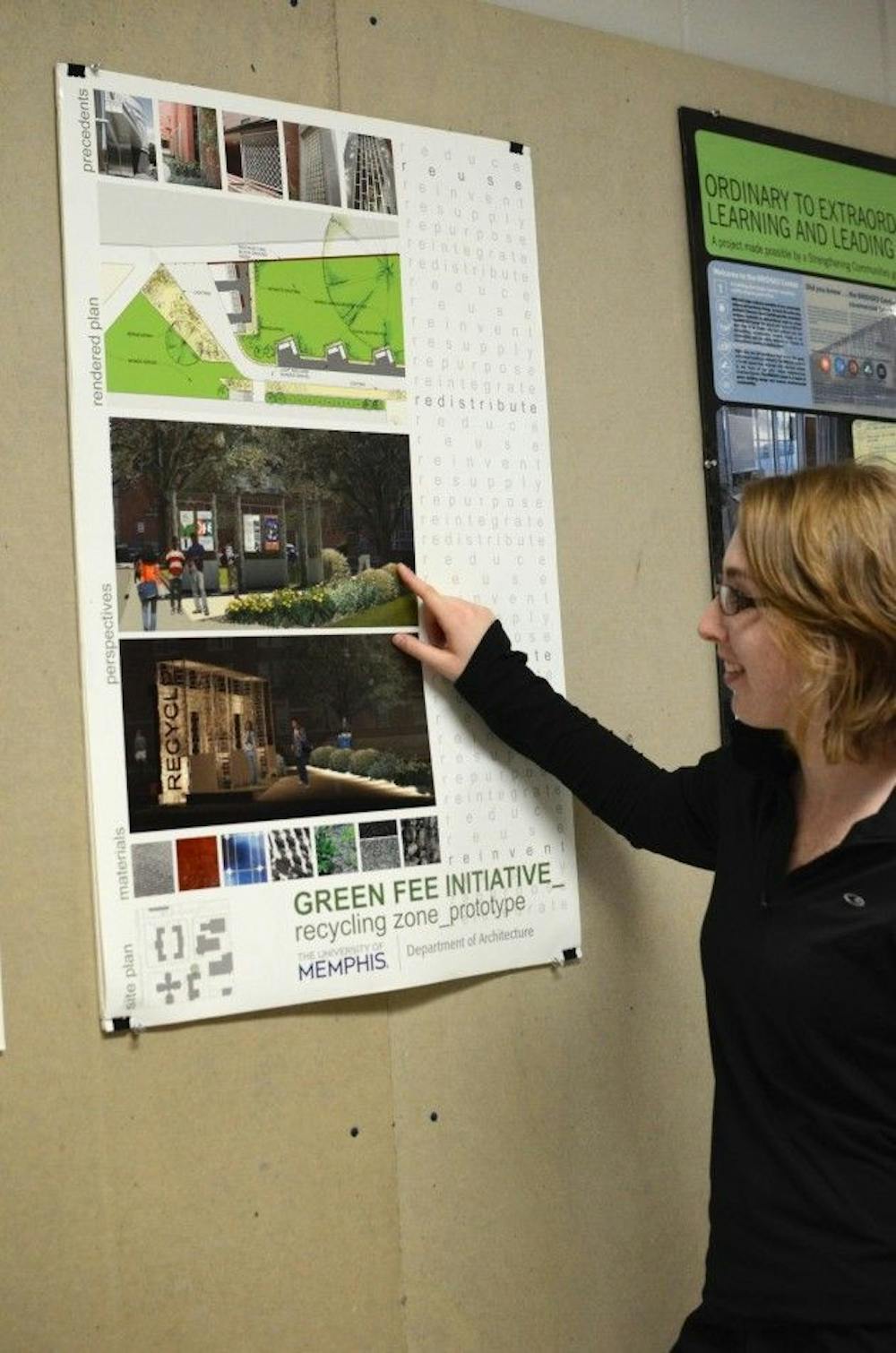
When the sun sets on Earth Day 2012, a new campus pocket-park that allows students to relax and recycle will light the corner of Desoto and State streets with it's LED lights.
The architectural Green Team designed and proposed the idea for a campus recycling zone to the Green Fee Committee two years ago. Originally an $18,000 project, the idea was turned down due to a renovation to a neighboring area of the project's location, Mynders Hall, said Jennifer Thompson, the project's co-manager.
With the help of a new student organization called R3, the recycling prototype blossomed into something more, along- a park and outdoor learning space. It was approved last year with a new allowance of $35,482.
"We walk by the site every day, and it used to be a broken asphalt driveway with an ugly Dumpster. People would park their cars illegally," said Megan Hoover, member of the Green Team. "We decided that recycling is something that needs to be talked about more on campus."
The park is comprised of drought-tolerant indigenous plants, reused sun shading panels, a rubble wall, LED lighting, recycling bins, benches and a permeable gravel walkway.
The 6,015 square foot project is a collaborative effort. Shelby County government donated the shading material made of brise-soleil that was taken from an entire floor of an old office building located at 157 Poplar Avenue. A portion of the park is landscaped by Gardens Oy Vey.
Students played a major role in the project. Along with the designing and planning, students will install the brise-soleil enclosure, build the benches and plant much of the landscaping, said Sherry Bryan, project co-manager.
The gravel pathway will allow water to run into the soil instead of into storm drains. The rubble wall is made of donated broken cinder blocks, and above them will be educational placards that display information about different types of recyclable materials.
"Our rubble wall will be used as a thermal mass, so in the winter it will capture the heat from the sun. You can sit by it and it will keep you warm," Hoover said.
The indigenous plants will not only be used for landscaping, but will also be almost wall-like, creating seating-pod benches for students.
"This is something that we'd like to have at different locations on campus," Bryan said. "We'd love to have them in places like Millington and Jackson too. This project is more than going by a blue Dumpster and putting your trash in. It's really a place where we can stop and learn about recycling."