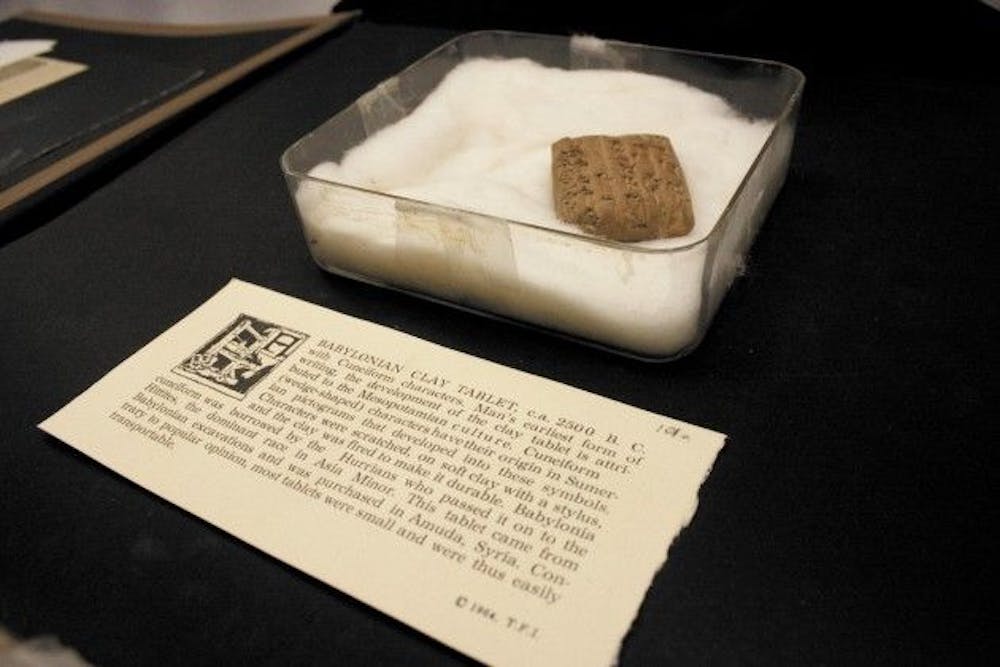
An original Babylonian clay tablet, circa 2500 B.C., resides in the Special Collections section at The University of Memphis library along with Egyptian cuneiform and medieval European manuscripts.
Pages from the Past is a collection of leaves from rare books and manuscripts across the world. The collection consists of 18 sets containing four portfolios.
The U of M's portion is set No. 16 in Portfolio Set I–IV: History of the Written Word. The related sets are at various research libraries around the world.
"One interesting aspect is that to create something like this nowadays would pretty much be a crime because [someone] has taken something out of its content and scattered it around," said Edwin G. Frank, curator of special collections.
Each leather-bound portfolio has about 20 pages of language manuscripts. The oldest pieces in The U of M's collection are Babylonian writings on clay tablets. Each original piece is mounted on black paper with a brief description, but is not translated.
In addition to Egyptian and Greek papyri and medieval European illuminated manuscripts on vellum, the collection also includes European incunabula and writings in Latin, German, Dutch, Greek, Gaelic, French and Spanish.
Records indicate no known origin, publisher or date when The U of M acquired it. The library card on the portfolio is dated 1979, but The University obtained it sometime before then, Frank said.
"It was such an oddity that we just don't know anymore. Did someone give it to us? Did we buy it? It's not possible to tell. Its sort of a mystery," Frank said.
According to WorldCat.org, a library database, George M.L. Brown compiled and sold leaf books of these artifacts circa 1926. Around 1964, Alfred W. Stites purchased the collection from Harold Maker and sold them. Stites released the leaf books in chronological sets with new, descriptive labels in leather-bound portfolios. On the cover page of The U of M's set, there is a signature, but no text with the actual name.
A few years ago, a scholar contacted Frank about The U of M's portion of the collection. The scholar attempted to put together the pieces of Pages from the Past in a digital format. He took photographs, but Frank said he does not know the scholar's progress and cannot disclose his name.
"Only 18 sets have been issued. When this edition is complete, it obviously ends this series for all of time," was written on an introductory page of the set by an unknown author.