The House of Representatives on Thursday voted 260 to 167 to keep the federal government running through the end of September — but not before a struggle that saw conservatives and liberals oppose the painstakingly crafted compromise spending plan.
Since the agreement was negotiated by the White House and House Republican leaders, it drew little resistance from most lawmakers. The Senate voted later Thursday to pass the $38.5 billion spending reduction package.
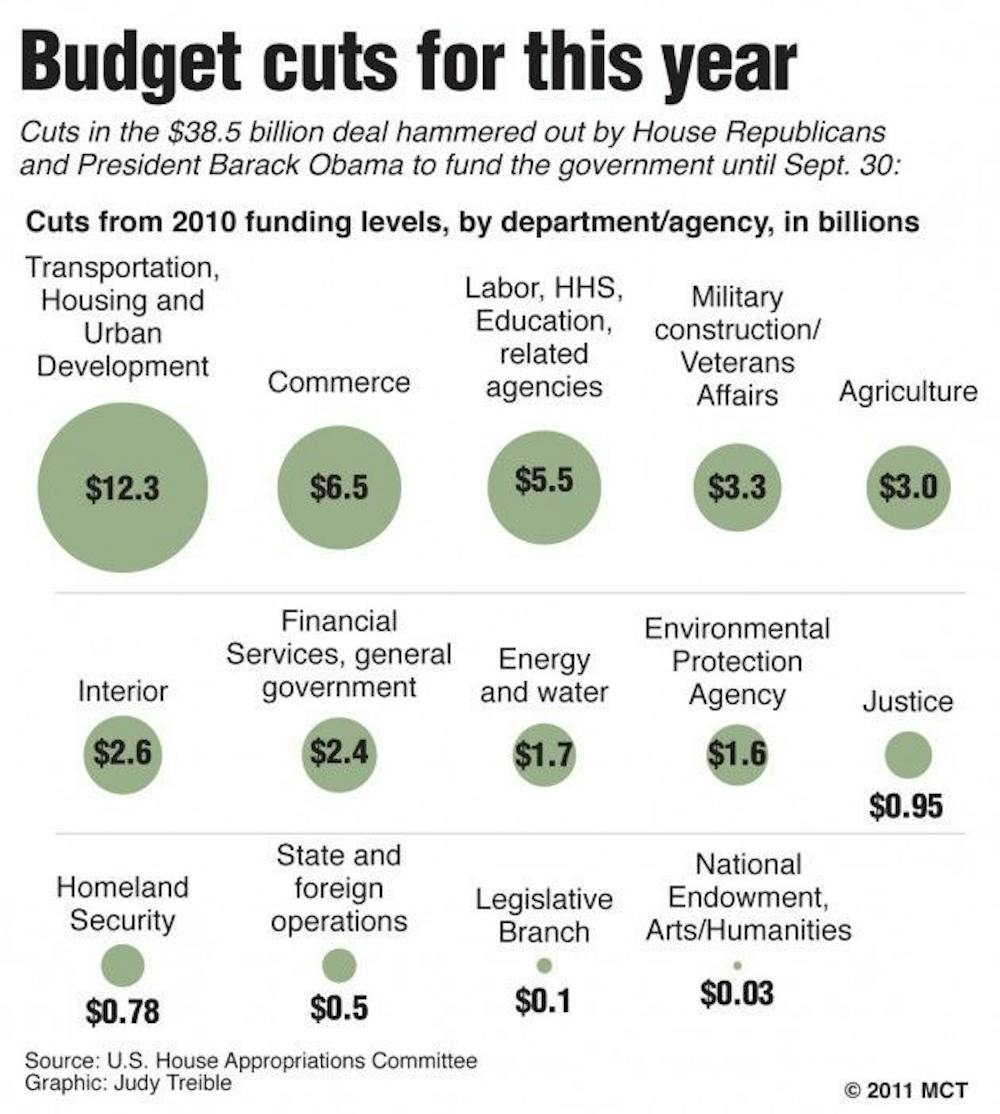
Among the biggest cuts are $5.5 billion from labor, education, and health and human services budgets, $3 billion from agriculture programs, $1.7 billion from energy and water programs, $784 million from homeland security and $2.62 billion from interior and environmental programs.
Congress itself will take a 5 percent hit, and will have to reduce office expenses.
But the Pentagon will get a $5 billion boost over last year's funding. The bill also bars Guantanamo Bay detainees from being transferred to this country for any purpose and prevents the construction or modification of detention facilities in the U.S. for their housing.
The bill also requires the defense secretary to certify to Congress that a transfer of a detainee to a foreign nation or entity "will not jeopardize the safety of the U.S. and its citizens." These measures are nearly identical to current law.
The bigger impact of the plan approved Thursday is its meaning for the budget battles ahead.
"To say it showed where harder positions are would be accurate," said Rep. Jack Kingston, R-Ga., a leading conservative. "We wanted more cuts."
But liberals such as Rep. Sheila Jackson Lee, D-Texas, warned there were already too many cuts.
She voted "a big fat no," and explained, "I don't believe this does anything but soothe minute favorite interests."
The House on Friday is expected to consider a series of budget plans for fiscal 2012, the 12-month period that begins Oct. 1.
Most likely to pass in the House, where Republicans have a 241 to 192 majority, is a package authored by House Budget Committee Chairman Paul Ryan, R-Wis., that could cut $4.4 trillion from projected federal deficits over the next 10 years.
Ryan would revamp the Medicare and Medicaid programs, and reduce the top corporate and individual tax rates, now 35 percent, to 25 percent.
President Barack Obama on Wednesday offered his own broad outline for deficit reduction. He'd cut $4 trillion from deficits over the next 12 years, mixing $3 in spending cuts for every dollar in tax increases. He would end the Bush-era tax cuts for the wealthiest Americans, and make no major changes in Medicare, Social Security and Medicaid.
Negotiators from both parties are expected to try to craft a compromise, starting next month.
But the Thursday vote sent signals from the conservatives who dominate the Republican Party and the liberals who make up much of the Democratic caucuses that they aren't about to move off their long-held positions.
House Minority Leader Nancy Pelosi, D-Calif., made it clear she's unenthusiastic about the fiscal 2011 and ready to fight for future budgets more to her liking.
"I feel no ownership of that or any responsibility to it," she said of the 2011 agreement, "except that we don't want to shut down the government.
Conservatives weren't crazy about the plan, either. Rep. Michele Bachmann, R-Minn., called the savings "a pittance."
The rhetoric was similar to views of the 2012 budget. Conservatives sent strong signals that they're not about to agree to any tax hikes, period.
"The best way to bring down the debt and to create the climate that will lead to good private-sector jobs and prosperity is not to repeat the policies of the past but to change them," said Senate Republican leader Mitch McConnell of Kentucky, "and that means cutting Washington spending, not squeezing family budgets even more."
But liberals countered they're eager to see fewer spending cuts for domestic programs, and more taxes on the wealthy. And they don't want to include those cuts as part of an agreement on the nation's debt limit, which is expected to be reached sometime next month.
Republicans want cuts before they'll agree to raise the limit, now $14.3 trillion. Liberals say forget it.
"This is not a leverage point," said Rep. Peter Welch, D-Vt., of the debt limit extension. "This is a moral obligation."
Democratic leaders, liberals, as well as the Congressional Black Caucus, are each expected to offer separate budget plans Friday.
The leaders' budget would freeze non-security discretionary funding, usually programs such as housing, education and social services, for five years. The basic structure of Medicare, Social Security and Medicaid would remain unchanged. And it would impose pre-Bush era tax rates on incomes above $200,000 for individuals and $250,000 for joint filers.
The Congressional Black Caucus' plan calls for the creation of a public health care option which they say would save the federal government $88 billion over 10 years.
The CBC proposes spending tens of billions of dollars more than Obama's budget proposal and the House Republicans' budget blueprint on job training programs, research, targeted health care services, infrastructure and high-speed rail.
The budget raises revenues by treating capital gains and dividends as ordinary income, a surcharge on top income earners, eliminating mortgage deductions on vacation homes and yachts, and closing certain tax loopholes.