When Brent Taylor arrived at his college psychology class on a recent Wednesday morning, he was surprised and mortified to discover that he had an exam that day worth 30 percent of his overall grade. Because of his frequent use of his laptop and other electronic devices in the classroom, he missed an announcement his professor had made the week before about the test date.
Taylor, 21, a senior, used some form of technology in every class he attended until he failed his psychology test, dramatically affecting his grade. He said that in classes where his professors allowed laptops, he used them to surf the Web, check his Facebook, update Twitter messages and stay up-to-date on ESPN highlights. If they did not allow laptops, he passed the time texting and accessing social media sites discreetly from his phone.
"I went in to class that day completely unaware that I was about to make the biggest ‘F' of my life," Taylor said. "I am now paying for my lack of attention to the professor and lectures because if I can't figure out how to pass this psychology class, I won't graduate."
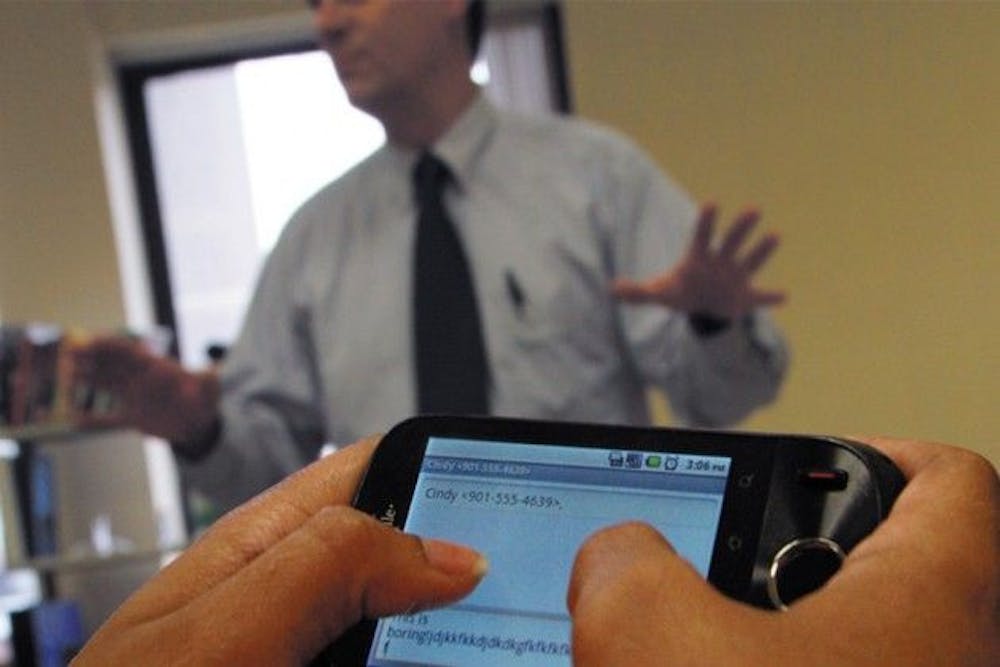
In a survey conducted by two psychology professors at Wilkes University, among 269 students from 21 majors, 95 percent of students said they bring their cell phones to class everyday, and 91 percent frequently use them during class time. About 10 percent of those surveyed admitted to using text-messaging capabilities to cheat on a test.
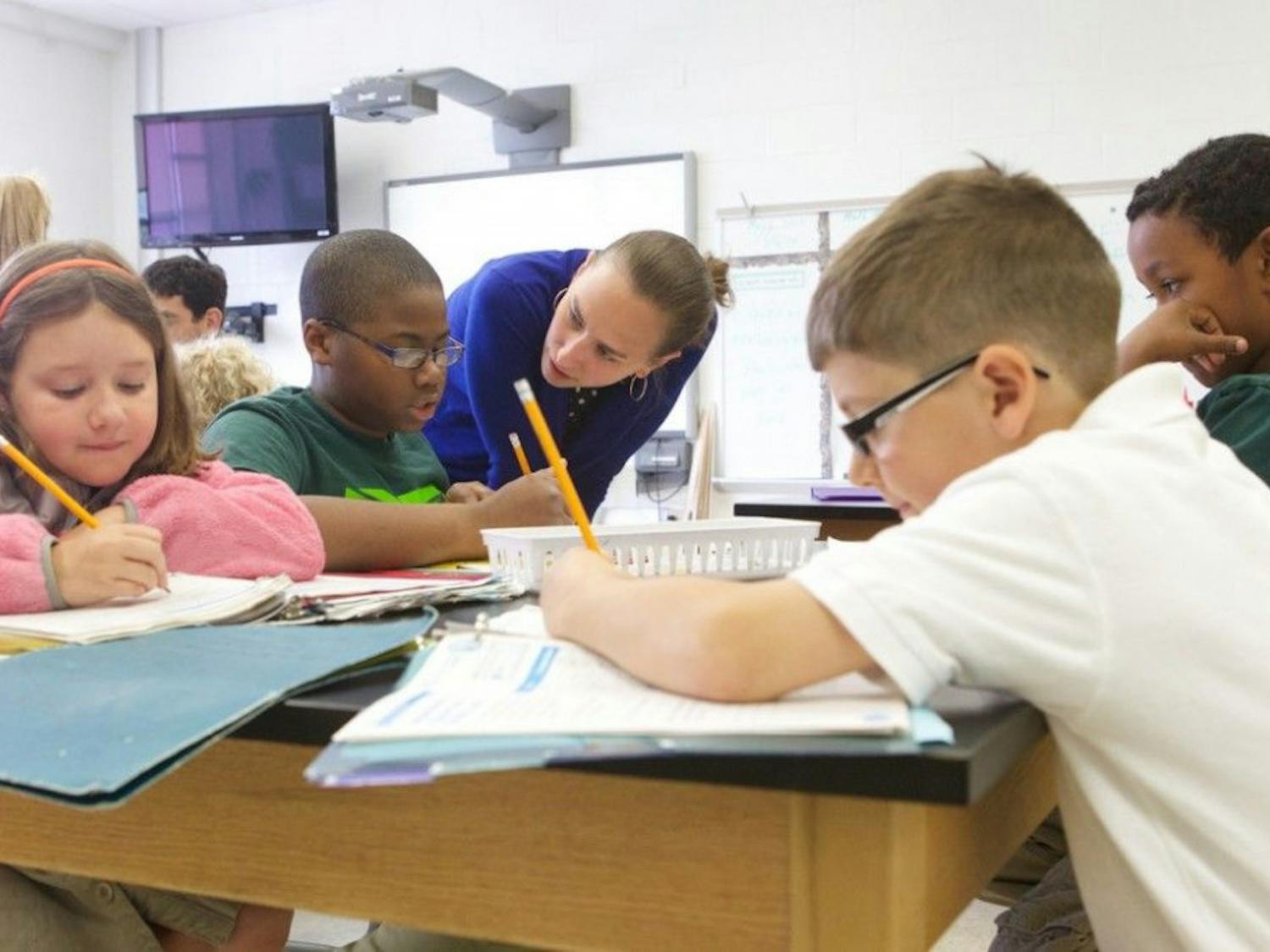
Today's classroom teachers are faced with the challenge of teaching students effectively with the proper technological tools, while at the same time limiting their pupils' access to technology to prevent distractions in the classroom.
For years, many teachers have advocated more technology in the classroom at younger ages, but by the time those students reach college, they find many professors banning laptops and cell phones from the classroom.
Michael Armour, adjunct political science instructor at The University of Memphis, has strict no-tolerance policies for any type of technology in his classrooms.
"In the past, I allowed cell phones and laptops; however, I soon learned that students abused these privileges," Armour said. "My policies are strict now because most young people do not have the discipline to concentrate on the course content exclusively."
Armour explained that students use their primitive brains instead of their frontal lobe and seek instant gratification, which is why they feel compelled to text or use Facebook, Twitter or other websites during class lectures. He said that students who follow his instructions and refrain from the use of technology do much better in his courses.
Kathy Zanone, English chair at Saint Agnes Academy in Memphis, said she believes that because of technology, students have a much harder time focusing and have become dependent, causing a decrease in work ethic.
"I believe that technology is a distraction much of the time and that students are no longer able to focus for long periods of time as a result," Zanone said. "Reading, vocabulary and spelling proficiency have declined in recent years as a result of technology. Work ethic is probably not as strong as in years past because it is so easy to find answers online."
In a research study conducted at Winona State University, 137 students from two sections of general psychology taught by the same professor completed weekly surveys focused on class attendance, experience and laptop use. Among those students, 64 percent reported using laptops to multitask during one or more class periods for about 49 percent of the time. Eighty-one percent reported checking e-mail, 68 percent used instant messaging, 43 percent surfed the Internet, 25 percent played games, and 35 percent reported doing "other" activities.
This research study also showed a negative correlation between level of laptop use and how clearly students felt they understood the lecture, which led to lower test scores.
However, some students and high school teachers said they believe that integrating technology into the classroom gives students the opportunity to excel and prepares them for college and the real world. Saint Agnes Academy is one of several Memphis-area private schools that provide students with their own personal laptops for school and home use.
Joy Maness, dean of Saint Agnes Upper School, said she does not think technology has been a distraction in the classrooms at her school. Rather, she has found that it helps prepare the students for life after high school.
"I think that having a laptop in students' possession helps them increase their creativity and better prepares them for their world in the future," Maness said. "The colleges that our students attend expect them to know how to use the technology for everything from signing up for classes to classwork."
St. Agnes, however, has a firewall set up to keep students from accessing social media sites such as Facebook, Myspace, Twitter and others that would cause a distraction to the learning environment, with the school's Internet technology department regulating students' online activity in the classroom.
Caitlin Cahill, 25, is a technology integration specialist for a public school district in Orono, Minn., and teaches adult classes on social media, as well as summer camps for elementary and middle schools students. This semester, she teaches Facebook for parents, Twitter for professionals and classes on getting started with Gmail and Google calendar. Cahill also hosts training sessions, speaks at conferences and creates presentations to help educate teachers and administrators about the importance of social media and technology in education.
"I do think that students can successfully multitask," Cahill said. "Studies show their brains have adapted as such, but they need to be taught when multitasking is appropriate and to what extent they can handle it because some students can handle more than others. For example, tweeting a question about class material extends their learning. Tweeting about what the teacher is wearing is distracting."
Cahill also said it is important to let students and teachers use their personal devices like cell phones and laptops in class.
Mario Ovelar, senior psychology major at The U of M, said that he brings his laptop to class to take notes or if he suspects he'll have trouble paying attention to a lecture. He said he thinks that throughout his college career, being able to have technology in the classroom has helped him retain more information and maintain his grade point average. Most of Ovelar's professors have a zero-tolerance policy for cell phones but allow laptops as long as they are not a distraction.
Elena Zavelli, former student at Saint Agnes and now a junior at The U of M, said being allowed to use computers in the classroom in high school prepared her for the college experience and the high expectations that college professors set. However, she also uses her laptop and cell phone in class for social networking.
"When I'm in class, I check my phone at least three or four times to see if anyone has updated their Twitter or Facebook pages, and when I have my laptop, I click on those pages even more often. I never let it consume too much of my time or distract me too much, though," Zavelli said.
At The U of M, the Department of Journalism offers a course on social media and mass communication to educate students on the basics of using Facebook, Twitter and the like as a tool for journalism, advertising and public relations.
Nicole Blum, senior broadcast journalism major, decided to take the class because she said social media skills are what future employers will be looking for and, if used the right way, will be the future of all reporting. This semester, Blum and her classmates have used Twitter, Facebook and personal blogs as assignments to create their own "personal brand." Blum's class also connected with a school in Cairo during the recent Egyptian revolution.