At the tree-lined entrance to the Stony Brook mobile home park in Raleigh, N.C., Maria Angelica Alvarez stood behind yellow police tape, clutching two bouquets of flowers and weeping on a friend's shoulder.
Alvarez lost her three young sons in a three-day, 14-state maelstrom that killed at least 44 people and could prove to be one of the largest convulsions of tornado activity in U.S. history.
The boys, ages 6, 8 and 9, were killed inside a bedroom, crushed by a tree that demolished their trailer. Alvarez's 6-month-old niece was hospitalized in critical condition, friends said.
"It's a catastrophe — she lost everything," said Consuelo Kwee, center director for Catholic Charities of the Diocese of Raleigh, as she tried to console Alvarez.
The vicious storm system has whipped up a reported 241 tornados since Thursday, according to state officials and AccuWeather.com. In all, more than 60 twisters touched down in eastern North Carolina, wreaking havoc among peanut farms and chicken houses of rural Bertie County, where 11 people died — as well as in Raleigh, the state's capital and second-largest city.
At least 22 people were killed across North Carolina late Saturday, and another five in Virginia. Earlier, the storm system killed seven in Arkansas, seven in Alabama, two in Oklahoma and at least one in Mississippi.
By Sunday morning, the National Weather Service had declared that the severe thunderstorms were gone, but the respite could be short-lived. Meteorologists said another storm system was likely to plague the central and southern Plains early this week and move east, possibly striking some of the same areas.
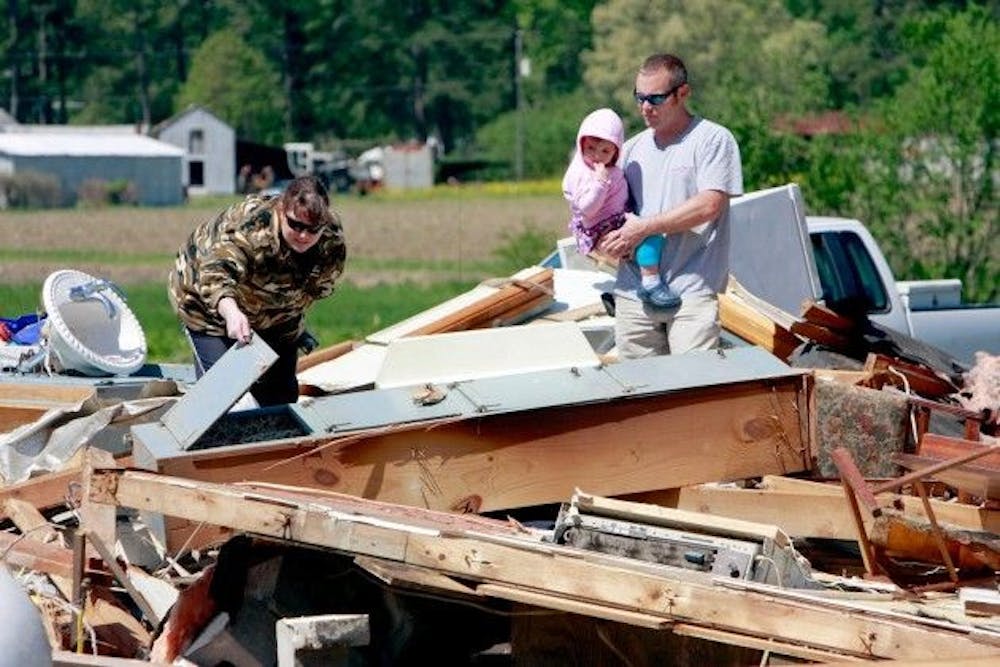
In Bertie County, N.C., a twister apparently ripped a course of destruction a half-mile wide and five to seven miles long as it moved northeast from the town of Askewville, said County Manager Zee Lamb.
"Where there were homes, there's nothing underneath it now," he said. "You've got trucks blown across the street. You just don't realize how powerful these storms are until you experience them."
Justin Dunlow of Askewville tried to shield his 3-year-old daughter and 5-year-old son as the double-wide mobile home where they had taken shelter was torn to shreds.
"I just started praying, and the wall fell on top of us, and that's what kept us there," he told the Associated Press. "I can replace the house, but I can't replace my babies. And that's what I thought about. I'm alive. My babies are alive."
North Carolina Gov. Bev Purdue declared a state of emergency and suspended restrictions on work hours for truck drivers — to allow for the delivery of goods to affected areas — and for utility workers, because tens of thousands of customers remained without power.
Virginia Gov. Bob McDonnell also declared a state of emergency. He planned to travel Monday to the southeastern county of Gloucester, where three people were killed Saturday and others were injured when a tornado touched down over a 12-mile path, lifting part of the roof off a middle school and destroying several homes.
Virginia officials said flash flooding killed two people in Waynesboro, in the Shenandoah Valley.
Back at the Stony Brook trailer park in Raleigh, residents — many Latino construction and restaurant workers — were barbequing or washing cars until moments before howling winds sent them dashing for cover.
Alvarez did not hear the tornado warnings issued by emergency authorities. Like many of the residents, she was not watching TV or listening to a radio, and she is not fluent in English, Kwee said.
Another resident, Daphne Flores, said she and her husband hid under a bed in their trailer when the sky turned black and fierce winds knocked over trees. Their trailer was one of only a handful that avoided damage, she said.
"There was no warning," Flores said, her Spanish translated by a friend, Saby Mazariegos. "Suddenly, people were screaming and crying, yelling out the names of family members."
Flores said her husband, Roberto, cut a hole through the roof of Alvarez's smashed trailer to reach her sons. The boys were dead. He covered their bodies with a shower curtain.
AccuWeather officials said it will take weeks to get an exact count of the tornados, but the event appeared to be the deadliest of its kind since 2008.
The abnormally extreme weather could be partially explained by warmer-than-usual waters in the Gulf of Mexico, which in turn supplied warm, moist air that significantly boosted the storm's power, AccuWeather said. Southwesterly wind in the upper atmosphere and southerly to southeasterly wind in the lower atmosphere created twisting patterns and wind shear that made tornados more likely.