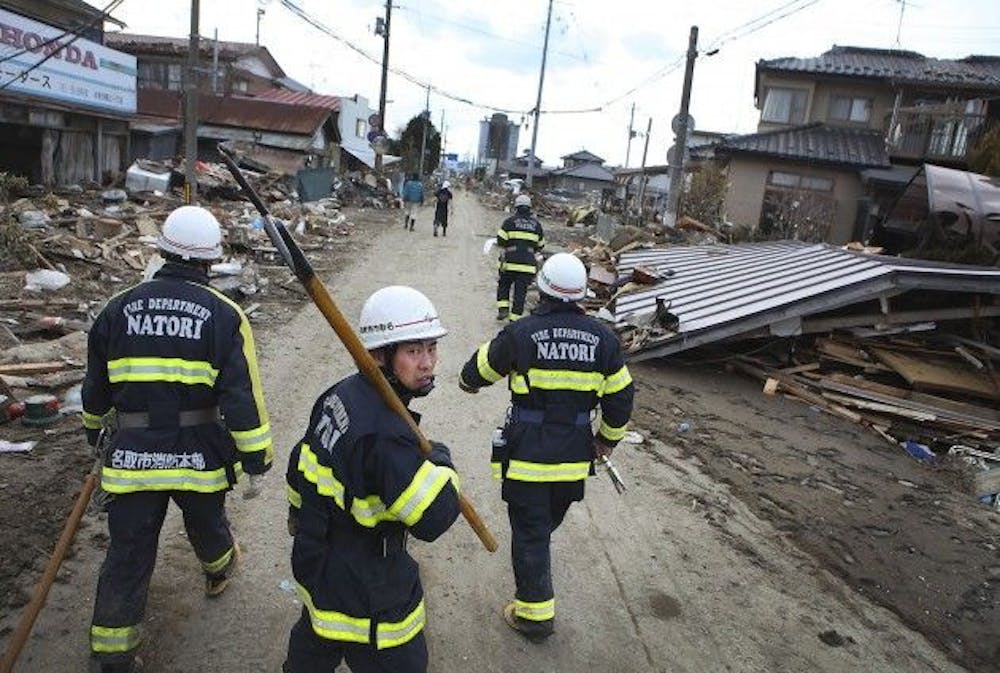
With a death toll expected to climb into the tens of thousands, more than a half-million people displaced and a nuclear crisis continuing to unfold, rescuers converged Monday on Japan's devastated earthquake zone while workers in relatively unaffected areas struggled to return to offices and factories.
The government reported Monday that radiation levels again rose above legal limits outside the crippled nuclear complex at quake-battered Fukushima, about 150 miles north of Tokyo, where authorities have been pumping seawater into overheated reactors to try to cool them down. Several other nuclear installations were under close watch for potential problems.
Across a wide swath of earthquake-hit territory, hundreds of thousands of hungry survivors roused themselves from a third cold night spent huddled in darkened emergency centers, cut off from rescuers, aid and electricity. At least 1.4 million households had gone without water since the quake struck and some 1.9 million households were without power. Rolling blackouts to conserve energy were scheduled across much of the country on Monday.
In Tokyo and other large cities outside the quake zone, the first full workday since Friday's temblor began with delays and disruptions. Many of the train lines that normally run between Tokyo and outlying suburbs and surrounding cities were either running far less frequently than normal or not running at all.
With fears about how the world's third-largest economy would weather the ongoing fallout from the massive quake, Japan's main stock exchange, the Nikkei, opened down Monday morning by just over 2 percent. The central bank said it was prepared to flood money markets with cash to keep the financial system running.
A full reckoning of deaths and damage could take weeks, but the picture grew grimmer with each passing hour.
"We have no choice but to deal with the situation on the premise that it (the death toll) will undoubtedly be numbered in the ten thousands," Naoto Takeuchi, head of the Miyagi prefectural police, told a Kyodo reporter during a local disaster task force meeting.
An international rescue effort gathered force, with teams arriving from China, New Zealand, Germany and the United States, among other nations.
"We are glad to accept all the help we can get to assist the people of Japan," said Air Force Col. Michael Rothstein, 35th Fighter Wing commander at Misawa. "We will do whatever is in our means to support their efforts in this time of need."
There were some dramatic rescues of tsunami survivors Sunday, including that of a 60-year-old man who had been waiting for help since he was swept out to sea Friday.
Hiromitsu Shinkawa was spotted by rescuers at 12:40 p.m. nine miles off shore by the crew of a Japanese Maritime Self-Defense Force destroyer, Jiji Press reported.
Shinkawa, from the devastated city of Minamisoma, was conscious and in "good condition" after the rescue, Japanese officials said.
"I ran away after learning that the tsunami was coming," Shinkawa told rescuers, according to Jiji Press. "But I turned back to pick up something at home, when I was washed away. I was rescued while I was hanging to the roof from my house."
In Rikuzentakata, a port city of about 20,000 leveled by the tsunami, Etsuko Koyama escaped the water rushing through the third floor of her home but was unable to hold on to her daughter's hand, she told Japanese broadcaster NHK. The girl was swept away by floodwaters and had still not been found Sunday, Koyama said.
"I haven't given up hope yet," Koyama told NHK, wiping tears from her eyes. "I saved myself, but I couldn't save my daughter."
About 5,000 houses in Rikuzentakata were submerged by the tsunami, and most of the 7,200 houses in Yamada were also under water, Kyodo reported. In Otsuchi, it swept away the town office.
Eighty-eight governments and six international institutions have offered assistance with recovery efforts, the Japanese Foreign Ministry announced.
Adding to the misery were more than 40 punishing aftershocks, three of magnitude 6 or higher Sunday.
The Japan Meteorological Agency said there was a 70 percent probability of a magnitude 7 quake in the next three days.
Officials from Tokyo Electric Power Co. began rationing power Monday to the 45 million people they serve to prevent Tokyo and nearby prefectures from experiencing massive blackouts, Kyodo reported.
Government officials said that the region-specific outages would affect a broad range of things used in everyday life such as traffic signals, medical institutions and train operations, and possibly result in water supply disruptions.
The power rationing should last until the end of April, officials said.
Banri Kaieda, Japan's trade minister, warned that the country's quake-damaged eastern and northeastern areas may suffer electrical shortages and urged large companies to limit electricity use, Kyodo reported.
Japanese Prime Minister Naoto Kan told reporters Sunday that his country was facing its most difficult challenge since World War II and called on his people to unite in the face of a devastating earthquake, tsunami and potential nuclear crisis.
"This is the toughest crisis in Japan's 65 years of postwar history," Kan said during a televised news conference. "I'm convinced that we can overcome the crisis."
In his remarks to the media, Kan said 12,000 people had been rescued, including about 5,800 people from Kesennuma, a city in Miyagi prefecture hit especially hard by the tsunami. Kan said 100,000 soldiers would be deployed to help quake victims.
While search-and-rescue teams struggled to reach battered parts of the northeast obstructed by mud and debris, new fears emerged over a meltdown at Tokyo Electric Power Co.'s Fukushima nuclear complex and trouble at two other nuclear plants.
Kyodo News Agency was reporting early Monday that a cooling system pump had stopped at the Tokai No. 2 nuclear power plant in Ibaraki prefecture operated by Japan Atomic Power Company. The same issue sparked the problems that have befallen the Fukushima reactors.
U.N. nuclear watchdog officials said Japanese authorities had notified them of an emergency at another plant farther north, at Onagawa. But Japan's nuclear safety agency denied problems at the Onagawa plant, run by Tohoku Electric Power Co., noting that radioactive releases from the Fukushima Daiichi complex had been detected at Onagawa, but that they were within safe levels.
Workers at Fukushima used seawater Sunday in a desperate attempt to cool down three damaged nuclear reactors. One of the reactors lost its outer shell in a hydrogen blast Saturday and another was under threat of doing the same, said the country's chief Cabinet secretary, Yukio Edano.
"Everybody in my neighborhood is being evacuated," said Teruko Tsuchiya, 53, who lives four miles from the nuclear plant and was lining up outside a 7-11 convenience store waiting for food. "The buses are going back and forth. People are scared, of course, but they are trying to stay calm."
Japan's nuclear and industrial safety agency said more than 70 people were believed to have been exposed to elevated levels of radiation, the Asahi Shimbun newspaper reported. Most were waiting to be airlifted from a field at the high school in Futaba, near Fukushima.
The International Atomic Energy Agency in Vienna said it was told by Japanese officials that they would distribute iodine tablets to residents near the plant. Iodine is known to protect against thyroid cancer that can develop from radiation poisoning.
The Ronald Reagan, a U.S. Navy aircraft carrier, was anchored off the coast of Sendai on Sunday, said Stephen Valley, a spokesman for U.S. Forces Japan. The nuclear-powered ship is being used as a floating refueling station for Japanese military and coast guard helicopters flying rescue missions in the area.
In Sendai, a city close to the epicenter, residents were charging cell phones on a generator set up by the municipality for traffic lights.
"We're stealing just a little electricity," said Sutomo Goto, 38. "Just enough for the cell phones. People were going crazy without phones. There is no information since we don't have TV. But we're OK here. Everything within 5 kilometers of the coast has been washed away."