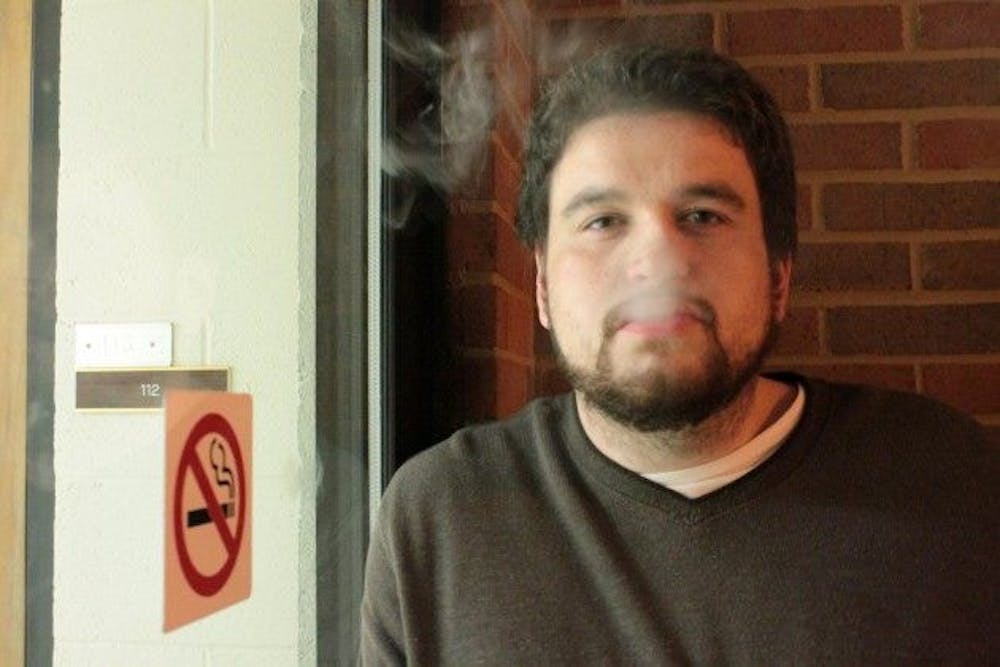
There's been a lot of talk about the University of Memphis' new limited-use tobacco policy as of late. The administration swore it would enforce the policy; the die-hard smokers swore they would mob and protest it.
But all the talk is just that and has led to nothing more than a lot of smoke.
When the policy was first introduced to the students, faculty and staff last year, fire came to the hearts and souls of the soon-to-be oppressed. But amid the rumors, the policy began to morph.
The Student Government Association found a compromise - smokers could continue their "nasty" habit, but they had to do it in designated smoking areas.
Then the questions came. Where would these areas be? Will they be covered? How far will tobacco users have to walk?
The answers came last month just before the policy took effect Oct. 1. The smokers must trek to the outskirts of campus and find their remote, designated areas if they wished to continue indulging in such horrible habits.
Following an encounter with U of M police Wednesday when he was asked to take his butt and his butts to Central Avenue and Patterson Street, freshman Christopher Peyton wrote a letter published by The Daily Helmsman that questioned a policy that was, in his eyes, put together without much student support.
I want to address some of his concerns, here and now. While the new policy was well intentioned, comments from both sides have shown that little has actually been accomplished.
He told me after he submitted his letter that he didn't know how something could be enforced without the consent of us, the students.
However, we as students go to the polls each spring and elect the SGA. They, along with the Faculty Senate, approved the implementation of the policy we now have.
In a video on the U of M website, SGA President Russell Born cited a study that "shows that approximately 69 percent of smokers want to quit." These numbers, along with the University's Healthy U campaign, led to the legislation that many smokers now oppose.
The U of M also has numbers attributed to the Centers for Disease Control and Prevention Fact Sheet that show that a majority of all lung cancer deaths are caused by smoking.
Another 11 percent of smoking-related deaths each year are due to second-hand smoke exposure. Peyton, however, pointed out in his letter that these studies of second-hand smoke are inconclusive.
"Importantly, these tests have proven that it causes harm, but only in the case of an unventilated area over an extended period of time," he said.
Peyton also brought up another talking point of anti-smokers - it just smells bad.
Well, they are right. It does smell bad, but so does some perfume, body odor and fertilizer. Apples to oranges? Let's look.
Several employers state in their workplace contracts that employees should bathe regularly and not wear strong colognes or perfumes, as they can be intrusive to customers and other employees alike.
Some people don't bathe as regularly as others and they have a variety of reasons for doing so. It may be for health reasons such as a weak immune system, religious reasons or maybe just because they are lazy. Whatever the reason, the University has not taken up a policy requiring students to bathe a certain number of times each week or assigned designated areas for those with B.O.
OK, so the worst part of smoking isn't the smell. But if it's having to walk through a cloud of smoke when you enter a building, why ban electronic cigarettes and smokeless tobacco?
Why not enforce the policy - on the books since 2010 - that requires smokers to conduct their business at least 20 feet from doorways. Why issue a new policy and still not enforce it with any real punishment? I would be less inclined to smoke a cigarette if it carried with it the possibility of a $25 fine. Cigarettes are expensive already. Call it the University tax.
Marian Levy, assistant dean at the School of Public Health, cited a 2010 U of M survey that showed 70 percent of students don't use tobacco in any form. No, 70 percent of the students who answered your survey don't smoke. Who cares? These studies aren't scientific - just because an unknown number of students self-select into a survey doesn't make it comparable to the law of gravity.
Don't get me wrong. I, as a smoker who does want to quit, find the smell of cigarettes intrusive, too. I'm sorry manufacturers have not come out with anti-odor cigarettes. Friends and peers constantly remind me that my cigarette break has left a not-so-tasty aroma on my person. I get it. It stinks. But so does manure. I don't walk past a tree with freshly laid fertilizer and complain. I walk past, and I deal with it. I don't demand the University stop using these things.
But I am a little disappointed in the smokers who complain about the policy under their breath and sneak off to smoke in inconspicuous areas. If you are so against the new policy, protest. When the policy went into effect, I half expected to see a flash mob in front of the Administration Building - smokers with cigarettes in either hand doing the Cupid Shuffle or something that drew attention. The U of M's health fair protests you, smokers, so much that they had a guy run around dancing in a sad-faced cigarette suit.
Until you speak up, things will stay the same. You will continue to smoke where you shouldn't until some authority figure asks that you comply. And you will. That is the same common courtesy you think of when you blow your smoke away from the non-smoking population anywhere else. And until the administration enforces the policy with a punishment not considered a slap on the hand, smokers will continue to defy the policy - myself included.
But to continue doing the same thing while expecting different results - that's the definition of insanity. And to be insane should be grounds for expulsion. So wise up, rise up and make your voices heard and your smoke clouds accepted.
Otherwise, accept that with every exhalation, you are and will continue to be just blowing smoke.